There are a practically limitless number of ways to evaluate any given piece of art. This is because art, being a form of expression, can not possibly be measured on a single axis. When I started up my own game studio, I often drew a parallel between developing a video game and organizing a stage play. Theatre necessitates the coalescence of many disciplines, the collaborative effort of many people, and the coordination of many mechanical systems. So too does game development. Take into consideration the additional element of interactivity and find that video games have become the closest exemplar of Richard Wagner’s gesamtkunstwerk.
Ultima: Exodus on the NES should not exist. It strains beneath the weight of existence. When the four characters that comprise your party stand alongside a fifth, non-player character, all five sprites begin to flicker. The hardware of the Nintendo Entertainment System can not accommodate five animated sprites on the same scanline, and so the game instructs it to display only four on any given frame. When the player moves about the game world, the game—in real time—calculates visible terrain using the party leader’s line of sight. Jumbled shapes and colors flit about in the periphery as bits of memory visibly shift. The entire game is 262 KB, which could fit almost ten times into the picture I took of my dinner last night.
And yet, it lives!
If we consider a “flaw” in a digital work to be something programmatically unintentional beyond a shadow of doubt, Ultima: Exodus is deeply flawed art. Game-altering bugs occur as early as the title screen, where Ultima: Exodus’s random number generator fails to seed itself when the player hits Start. Meanwhile, certain spells will always succeed on the second frame of the caster’s two-frame animation cycle, allowing any player to subvert “random chance” with sharpshooter accuracy. A line of dialogue critical to completing the main quest is incorrectly assigned; as a result, nobody ever speaks it.
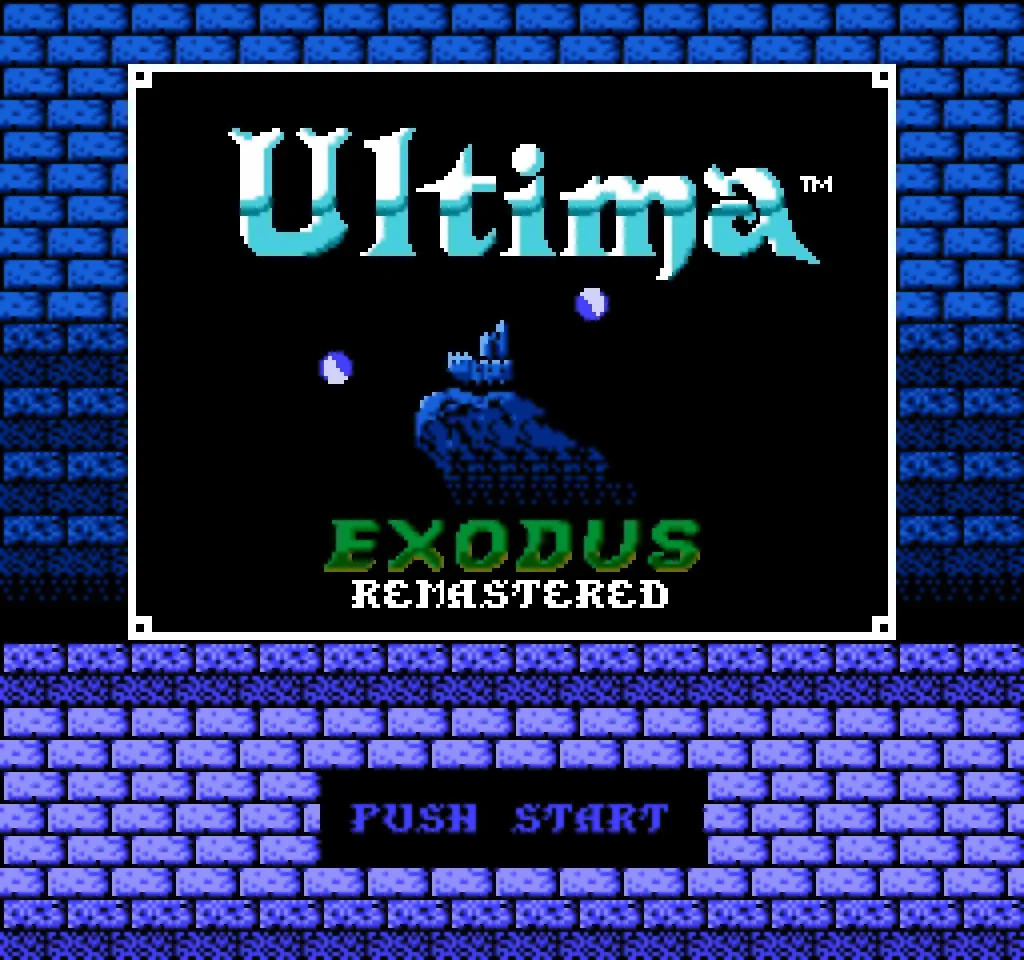
This is par for the course for role-playing video games of this era—the release version of The Elder Scrolls II: Daggerfall literally can not be completed, even with a guide—and we are able to examine these games with nearly forty years of pristine hindsight. On the level of technical achievement alone, I am conflicted in my evaluation of Ultima: Exodus. It is a confusing miracle of a video game. Coupled with the proliferation of NES emulation and ROM hacking tools, Exodus seems as obvious a candidate as ever existed for an after-the-fact fan-made software patch. This would arrive at last on December 29th, 2020, the eve of New Year’s Eve, in the form of Ultima: Exodus Remastered, the work of enterprising hacker Fox Cunning.
Ultima: Exodus gives us a startling approximation of the traditional Dungeons & Dragons tabletop gaming adventure on a home console, considering the resources available. The only reference material was essentially itself—Ultima III: Exodus (the 1983 original) for the Apple ][ was the blueprint for this type of experience, and arguably for the entire JRPG genre that blossomed from Japanese developers’ fandom for the game. It is, as far as software for the Nintendo Entertainment System goes, a Mona Lisa. From this angle, playing Ultima: Exodus Remastered (or hereafter, “UER”) is like looking at an updated version of the Mona Lisa where we can see exactly what she is smiling at. I will leave the philosophical fallout of this comparison as an exercise for the reader.
Food for thought: several enemies, such as trolls and zombies, that are present in the computer game Ultima III: Exodus are absent from Ultima: Exodus. This is not an oversight, but a conscious design decision. An obvious explanation is that the storage and memory constraints of the Nintendo Entertainment System, compared to the PCs of the time, rendered some omissions necessary. Time has proven this untrue. UER ports just about every enemy from the PC version to the NES, including the high-level versions of orcs, undead, bandits, demons, and “snatches.”
Yet another spell, one allowing the party to recall themselves from danger, is intended to permanently damage the Wisdom stat of its caster—a dire consequence. Instead, this spell subtracts from one of the color values of the character’s palette. In this instance, UER subverts both the oversight and the intended effect by instead programming the spell to reduce the caster to one hitpoint.
A cursory web search for opinions on Ultima: Exodus yields dozens of nostalgic recollections, all of which say exactly these two things:
- I was amazed at the scope and depth of the game compared to basically every home console game that preceded it. The world was completely open for you to explore. People and towns and dungeons were placed down without any narrative reason, they just existed for you to find. You could fight and steal from anybody.
- I had no idea how to progress.
Before playing Ultima: Exodus Remastered, I studied as if preparing for an exam. Frankly, I lack both the constitution and the life situation to complete this game without a guide. You may disagree with my scholastic approach to playing a video game, but it is more important to me that you understand the perspective of this review. Having to locate a random island in the middle of the ocean and dig four times to obtain a necessary item, par exemple, is an element of the game’s design that can so obviously be improved upon that I did not find it worthwhile to undergo or review the raw experience.
Video games can convey their own rules to the player. This makes them unique among games. Give a caveman a chess set or deck of cards, and they will be completely devoid of meaning. Give him a NES and Super Mario Bros. and he will eventually complete it. The game uses positive and negative audiovisual feedback to goad the player into eventually pressing the buttons that will prompt the credits. This is far from true of every video game, especially those released in the previous century, but it is a quality that critics have come to treasure because it gives video games a unique place in the canon of art: the interactive experience that guides itself.
Works like The Tower of Druaga (a game that my brother was quick to compare with Ultima: Exodus) that rely entirely on outside, shared knowledge to complete are still video games, but they fail to distinguish themselves from chess or poker on a foundational level. Works like Ico could literally only be video games. While I think that a caveman could eventually complete Exodus, it is far closer to Druaga than to Ico on this sliding scale. As Exodus is not an action game, we can not measure its difficulty based on the physical dexterity demanded of the player. Rather, we can measure the amount of information needed to meet the player’s objective that is disseminated to the player via the game (akin to the difficulty of a Sudoku puzzle). By this metric, Ultima: Exodus is not only difficult but downright hostile.
This is far from the only obstacle that awaits a prospective UER player. Rather than the traditional turn-based trading of strikes that console RPG fans will be familiar with, Ultima: Exodus offers full tactical combat on a grid against several opponents with about the same frequency. Mechanically, the rules of combat are a serviceable vehicle for conveying the “action”; in practice, they are downright maddening. Remastered refactors some of the internal logic to speed up actions in combat, which if anything reveals that the issue is more fundamental. A role-playing game with bespoke encounters such as Fallout or Baldur’s Gate benefits from the depth that tactical gameplay provides. Any game that throws random monsters at you like wild Pokémon does not. The unfortunate pace and density of combat is an issue endemic to JRPGs that Ultima creator Richard Garriott might actually be responsible for. Final Fantasy IX is one of my favorite games ever made, but I have used the original PlayStation release as a sleeping aid for exactly this reason. There is a reason that many classic Square Enix offerings are remastered with a built-in fast-forward function.
And this touches on the issue: there is not too much action—the action is far too slow. Animations are glacial and the game seems to sweat while making even boilerplate calculations. Toggling on the fast-forward feature of my emulator often remedied the issue entirely. In fact, I settled into a really fun and satisfying cadence—move my paladin into melee range, line up my thief for an arrow shot, duck my cleric into cover. Aligning my intentions to the grid became satisfying in a kinetic way: my fingertips were expressing individual characters, and I was enacting my will as fast as I could conceive of it. Modern technology allows one to babysit the flow of gameplay in just about any console video game released before 2005. Seeing as UER is expressly designed to be played with an emulator, the slack I will cut here is downright tremendous. At the end of the day, I was handed both something unpalatable and the means to enjoy it.
In 2020, I saw TOOL perform at the Bridgestone Arena in Nashville, Tennessee. Before “Swamp Song,” Maynard James Keenan addressed the audience: “when this song was written, some of you were not even sperm.” This particular phrasology has stuck with me ever since, and I believe it to be especially pertinent to the realm of ludography. Games released after my birth (in 2000) look like video games. Games released before my birth look like downright artifacts. This arbitrary watermark has colored my relationship with the medium incontrovertibly.

Graphically, Ultima: Exodus looks fairly bad. Ultima III: Exodus on the Apple ][ looks solid for its hardware, where I would consider something like Prince of Persia or King’s Quest IV to be the high watermark. On the console that gave us Metroid and Castlevania III: Dracula’s Curse, the sprites and tiles of Exodus look incredibly crude. For a more direct, party-based overhead RPG comparison, look at the player characters and monsters in Dragon Warrior III, or Final Fantasy II. Look at the trees and the mountains (though, I will concede that Ultima: Exodus has some excellent 8-bit water tiles). For awesome first-person environment work in a dungeon crawler on the Nintendo Entertainment System, look no further than Digital Devil Story: Megami Tensei II. Different perspectives for overland travel, delving, and combat mean that this game smokes Exodus in multiple dimensions.
“Charming” is often used to excuse resourceful art from a bygone era, but Exodus is wanting even for its era. I would venture to call certain pieces of art direction “so bad it’s good”—the hot pink cleric with her heart-shaped shield comes to mind, as does the nigh-unintelligible mess of characters that constitutes the status menu. UER, commendably, entirely overhauls the visuals of the game:
- The UI font is now suitably medieval as opposed to a blocky system font.
- Character sprites and portraits are now inspired by the artwork of 1990’s Ultima IV: Quest of the Avatar port to NES, also developed by FCI and Pony Canyon. Unlike Exodus, Quest of the Avatar had been overhauled both visually and mechanically to better suit the NES hardware.
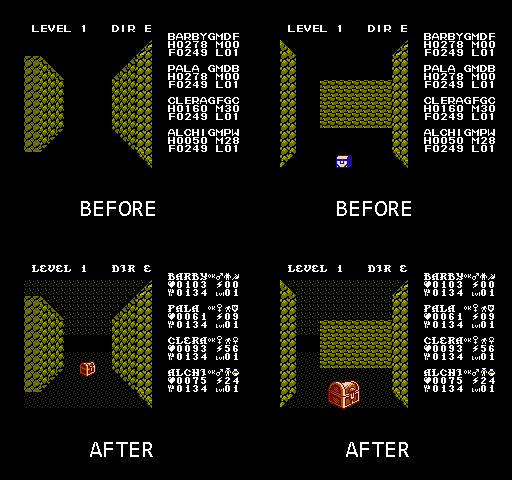
- Dungeons now look visually distinct from one another, have ceilings and floors, and even feature rudimentary depth—chests can now be seen as you approach them, rather than when you stumble upon them.
- Many NPCs now have portraits when you talk to them.
I will never retire from working. This is not some political lamentation about the state of the world economy, nor a prognosis of my personal health. Fantasies of wiling away my 70s playing bingo and coddling grandchildren simply do not occur to me. They are wafer-thin impossibilities. I know for a fact that I will not live to see this old age. With the spiritual certainty that a religious devout knows where they will go after they die, I know about how far I’ll go before I die. I would be happy to be wrong about this, but it no longer bothers me.
There is a cerebral comfort in using my limited time on Earth to soliloquize about a ROM hack of the tenth of thirteen ports of the third of nine role-playing video games that helped to shape the genre. You really only get one shot at deciding whether or not you want to play this game during your life. I felt that I did, so I loaded it up, and I generally had a good time with it. I’d even like to play it again some day—I already find myself thinking about different viable party compositions. My score doesn’t constitute a recommendation because you already know whether or not you will enjoy UER. Every video game review that indicates a numerical score is in service of either the author’s ego or IGN’s bottom line. There exists no in-between.
The best compliment a critic can give to a video game remaster is that it preserves the spirit of the original game, presenting it “the way you remember it.” I can not speak to this quality of UER because I have no memories of Ultima: Exodus. Honestly, though, if you have a way to play UER,don’t play Ultima: Exodus. The existence of the former exculpates the latter while also placing it on a shelf. It is an article of historical fascination. It belongs in a museum.